Baseball Cards Worth Money: 2026 Value Checklist
Pre-1970 Hall of Famers and gem-mint star rookies are the baseball cards worth money — most 1987-1994 cards sell for under a dollar. Price yours in 4 steps.
Two Steps to a Real Number
The cards worth money are pre-1970 Hall of Famers, 1909-1915 tobacco issues, and graded-10 rookies of modern stars. Do these two steps first, then read the full walkthrough.
Step 3 is a lookup you repeat once per card, and mental tallies go stale. The tracker does the bookkeeping: list each card, jump straight to its eBay sold comps, and watch the collection total add up. It saves in your browser only — nothing reaches our servers.
Open the collection value trackerSold prices are the only free price guide that matches reality, and live auctions are the closest read on where they're heading. These are real eBay listings with current bids — the lookup Step 3 asks for, already open.
Graded baseball rookies selling right now
LIVEReal-time eBay auctions · bids shown are current · tap a card to bid on eBay
Browse every live “PSA 10 baseball rookie card” listing on eBay →
Which Baseball Cards Are Worth Money?
Three groups carry nearly all the money in the hobby:
- Pre-1970 Hall of Famers — any card, any condition. So few survived that even a worn 1961 Topps star has buyers.
- Tobacco-era cards, 1909–1915 — the T206-type issues. Worth checking regardless of who is on the front.
- Gem-mint rookies of modern superstars — Griffey 1989 Upper Deck, Jeter 1993 SP, Trout 2011 Update, Ohtani 2018 — and only in graded-10 condition.
Everything printed from 1987 to about 1994 usually sells for under a dollar, stars included. That is what most inherited collections are made of.
Two copies of the same card can still differ by a dollar to a thousand on condition alone, so there’s no single “book value” that matters anymore: the real price of any card is what comparable copies have recently sold for. The four steps below find that number for your own collection — date the cards, hunt the names worth checking, grade the condition honestly, then look up real sold prices and decide what to protect, grade, or sell.
Start Here: The 60-Second Triage
Before anything else, answer one question: when are the cards from? Flip a few over — the copyright year is printed on the back. That year sorts your collection into one of three completely different situations:
- Pre-1970: Stop. Handle carefully. You may have real money. Read everything below.
- 1970–1986: Worth a careful look — stars and rookies have value, especially in sharp condition.
- 1987–present: Almost certainly modest, with specific exceptions covered below. (Sorry. It’s everyone’s situation, including ours.)
The reason is pure supply: in the late 1980s card companies discovered collectors would buy anything, and printed accordingly. Billions of cards from the “junk wax era” survive in mint condition, which is why a 1989 Topps star card buys a cup of coffee while a 1959 Topps version of the same caliber player buys the whole café.
Step 1: Hunt the Names That Matter
Go through the cards and pull anything featuring these tiers:
Inner-circle vintage legends (any card, any condition): Babe Ruth, Lou Gehrig, Joe DiMaggio, Ted Williams, Jackie Robinson, Mickey Mantle, Willie Mays, Hank Aaron, Roberto Clemente, Sandy Koufax
Any Hall of Famer pre-1975 — even worn copies have buyers.
Modern era (1987+), only these matter: rookie cards of superstars — Griffey Jr. 1989 Upper Deck, Jeter 1993 SP, Trout 2011 Update, Ohtani 2018, Acuña 2018, Judge 2017 — and serial-numbered cards, autographs, or anything that says “refractor.”
Rookie card identifiers: look for “RC” shields (post-2006), or check if the year matches the player’s first season. The rookie card is almost always the valuable one — our vintage rankings show the pattern clearly.
Step 2: Read the Condition Like a Grader
Two copies of the same card can differ in value by 100x on condition alone. Check four things under bright light:
- Corners — sharp like a fresh playing card, or rounded/white from wear?
- Centering — are the borders even? Tilted prints lose value fast.
- Edges — clean, or chipped/fuzzy?
- Surface — scratches, creases, print lines, stains? A single crease drops a vintage card several grades.
Be ruthless. Collectors describe their own cards a full grade better than reality, then get disappointed at sale time. If a card matters, the market will eventually demand a professional opinion anyway — that’s what grading is for.
Step 3: Look Up Real Baseball Card Prices (Not Wishes)
The only free price guide that matters: eBay sold listings.
- Search the card precisely: year, brand, number, player — “1956 Topps #135 Mickey Mantle”
- Filter to Sold Items — asking prices are fiction; sold prices are the market
- Match condition honestly — a raw card matches raw sales, not the PSA 8 sale
- Check several sales — one outlier sale isn’t a price
For graded cards, search the exact grade. The difference between “PSA 8” and “PSA 9” sold prices will tell you instantly why the grading decision is the biggest lever in your collection’s value.
Working through more than a handful of cards, you’ll want to keep a running tally instead of a mental one. Our collection value tracker lets you list each card, jump straight to its eBay sold comps, and watch the total add up — everything stays in your own browser, so it’s a private worksheet for exactly this step.
Step 4: Decide the Fate of Each Tier
The stars (your clearly valuable cards): protect immediately — penny sleeve and rigid holder, no exceptions. For the genuinely valuable, grading multiplies sale prices: vintage Hall of Famers in honest condition are the textbook submission (see our grading prep guide).
The middle tier: sell raw on eBay individually or in themed lots, or trade them into your collection’s focus. Protect them in the meantime — the storage ladder costs pennies.
The bulk: junk-era commons sell by the thousand-count box for very little, or become the world’s best gateway gift — a kid with a 1989 binder becomes tomorrow’s collector. Honestly, vintage-style repacks like Ultra Pro Toploaders and Card Sleeves Bundle – 3” x 4” Clear… exist precisely because ripping old packs is more fun than the cards are valuable.
The Selling Channels, Ranked
| Channel | You get | Effort | Best for |
|---|---|---|---|
| eBay individual listings | ~85-90% of market | High | High-value key cards |
| eBay lots | Market for lots | Medium | The middle tier |
| Auction houses | Strong for premium | Low | High-value vintage |
| Local card shop | 40-70% of retail | None | Speed and bulk |
| Facebook/forums | Varies wildly | Medium | Known communities only |
The classic maximizing play: grade and individually sell the top cards, lot out the rest. The top 5% of a typical inherited collection carries 90%+ of the value.
What If the Collection Is… Modern?
If you’re sitting on cards from the last decade: same process, different emphasis. Condition is assumed perfect (so only gem-mint matters), rookies and serial-numbered parallels carry essentially all the value, and the market moves with player performance in real time. Our guides to which modern brands hold value and whether cards make sense as investments cover the modern landscape — and if you’re deciding what today’s equivalent of your old collection would be, that’s literally 2018 Topps Baseball #700 Shohei Ohtani Rookie Card Graded PSA….
The Bottom Line
Most collections are worth less than hoped, and more than nothing — and the sorting process above finds the exceptions fast. Date triage → star hunt → honest condition check → sold-price lookup → protect, grade, or sell accordingly.
And if the box turns out to be 1991 Donruss all the way down? Welcome to the club. Sleeve the childhood favorites anyway — it costs almost nothing — and enjoy the best part: you now know exactly how the hobby works.
Supplies and Slabs Mentioned Above
Submission supplies and graded examples referenced in this guide — our verdict, current availability, and who each one suits.

Every collector’s first supply purchase

Protecting your collection

Blue-chip modern card investing

Casual collectors and gift giving
Every collector’s first supply purchase
Protecting your collection
Blue-chip modern card investing
Casual collectors and gift giving
Shop these on eBay
Graded singles and slabs trade on eBay, not Amazon — these open live listings so you can check real sale prices before you decide to buy a slab or grade your own.
Recommended Products for This Guide
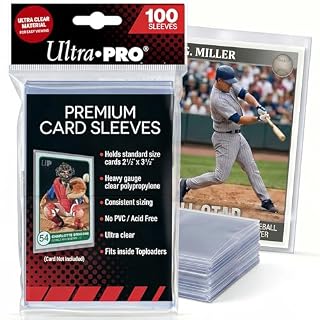
Ultra Pro Premium Clear Card Sleeves, 2.5" x 3.5", 100 Pack | Soft acid-free, non-PVC polypropylene sleeves protect standard Pokémon, MTG, baseball and football cards.
Amazon →

Card Sleeves Hard Plastic, Arjiekwei 3"X 4" Trading Card Holder, 35PT | Baseball Cards Protectors for Sports Football Game Cards (200 Hard Sleeves + 200 Soft Sleeves)
Amazon →

2018 Topps Baseball #700 Shohei Ohtani Rookie Card Graded PSA 10 Gem Mint
Amazon →

Ultra Pro 3" x 4" Clear Regular Toploaders & Card Sleeves Bundle, 200 Pack | Durable Rigid Plastic Protection for Valuable Collectible Cards with Crystal Clear Display During Storage, Trading & Shipping
Amazon →