2025 Topps Heritage Baseball Review & Checklist
2025 Topps Heritage checklist and set structure: the 500-card base set (400 base + 100 high-number short prints), the image/nickname/flipped-bat variations, the full parallel ladder, Real One Autos, and the High Number extension — plus box configs and whether Heritage earns a spot in your collection.
Overview
2025 Topps Heritage Baseball hit shelves in late April 2025 (released April 23) with arguably the most anticipated Heritage design in years: the 1976 Topps throwback. The colorful position banner, the cartoon silhouette figure at the bottom, the team-colored block backdrops — Heritage collectors had been waiting for the ‘76 design to roll around, and Topps executed it faithfully.
Heritage is its own category in the modern hobby. It isn’t about the latest rookie class or the shiniest parallels. It’s a set built for collectors who love vintage Topps design and want to relive it with today’s players on the fronts. The 500-card base set, the short-printed high numbers, the Real One on-card autographs, the chrome variation subset — every Heritage release uses the same formula, and 2025 delivers it on the back of one of Topps’ stronger design vintages.
This set is for a specific kind of collector. If you care more about the cardboard than the hit, 2025 Heritage belongs in your year. It’s also a product that rewards patience: Heritage boxes tend to feel better two or three boxes deep, when short prints start filling in and the base set begins to resemble a real 1976 binder page.
Box Configurations
2025 Topps Heritage ships in a full complement of formats, from hobby down to retail:
| Format | Packs × Cards | Price tier | Guaranteed Hits |
|---|---|---|---|
| Hobby Box | 24 × 9 = 216 | $$$$ | 1 auto or relic |
| Hobby Jumbo Box (HTA) | Fewer, larger packs | $$$$$ | Multiple hits |
| Retail Blaster | Sealed retail box | $$ | No guarantee |
| Retail Mega Box | Sealed retail box | $$$ | Exclusive chrome parallels |
| Hanger Box | Single jumbo pack | $ | No guarantee |
The Hobby box is the core of the product — 216 cards is a substantial rip, and the one-hit-per-box structure is a fair trade for how much base and insert cardboard you actually get. HTA Jumbo is the serious chase for set builders and hit seekers who want the extra auto/relic count. Retail blasters are a perfectly enjoyable cheap rip for the design alone.
Set Structure & Checklist
Heritage is built the same way every year, and understanding the numbering is the whole game for a set builder. Here’s how the 2025 checklist is laid out:
| Tier | Card Numbers | Count | What it is |
|---|---|---|---|
| Base set | #1-400 | 400 | The standard base run — every team, veterans and rookies |
| High-number short prints | #401-500 | 100 | Short-printed cards that complete the 500-card “master” base set |
| Heritage High Number (separate release) | #501-725 | 200 | A late-year release adding call-ups, traded stars, and rookies |
The core 500-card set is the classic Heritage build: a 400-card base run (#1-400) plus 100 high-number short prints (#401-500). The short prints are seeded at lower ratios than the base (see the odds below), which is exactly what makes finishing a Heritage set a genuine multi-month project rather than a weekend of ripping.
Within that #1-400 run, Heritage folds in subsets numbered right alongside the players — 2025 includes Record Breakers, Father & Son, and League Leaders cards, styled in the period-correct 1976 subset treatments. They aren’t separate inserts; they’re base cards with their own numbers, so they count toward the 500-card build.
Then there’s the twist that trips up first-time Heritage builders: the Heritage High Number set. Released separately later in the year (December 2025), it extends the checklist with a 200-card run numbered #501-725 — rookie call-ups, mid-season trades, and stars who signed after the flagship set was printed. If you want a complete year of Heritage, you need both the main set and the High Number set; we stock the Heritage High Number Hobby Box for exactly that chase. New to reading these? Our guide on how to read a baseball card breaks down what the card number, the copyright line, and the back actually tell you.
Short Prints & Variations
Short prints and variations are where Heritage separates the casual ripper from the set builder — and where a lot of value hides in plain sight, because a variation looks almost identical to a common until you know what to check.
High-number short prints (#401-500). The primary SP chase. Pull rates by format (printed on the wrapper):
| Format | High-Number SP Odds |
|---|---|
| Hobby | ~1:4 packs |
| Value Blaster | ~1:4 packs |
| Mega | ~1:4 packs |
| Fat Pack | ~1:3 packs |
| Hanger | as rich as ~1:1 depending on configuration |
Image & photo variation short prints. Layered on top of the base run, 2025 Heritage carries several variation types that swap the photo or a back-of-card detail. Beyond standard image/photo variations, look for Nickname variations, Flipped Bat variations, and Alternate Cartoon variations (a different cartoon printed on the card back). These fall at short-print odds and are easy to mistake for a base card — the reason experienced Heritage collectors sort a box slowly, comparing each big-name card against the base image before filing it as a common.
The takeaway for a set builder: a “complete” Heritage base set can mean the 400-card run, the full 500 with high-number SPs, or the full master with every variation — decide which finish line you’re chasing before you start buying singles.
Rookie Class
Heritage’s rookie class is effectively Topps flagship’s rookie class rendered in 1970s design, so there is meaningful overlap with 2025 Series 1:
- Paul Skenes — the 2024 ROY, carrying a Heritage rookie card that looks genuinely beautiful in the 1976 layout.
- Jackson Merrill — runner-up in 2024 ROY voting; a clean Heritage RC that pairs nicely with his flagship.
- Wyatt Langford — Rangers rookie with elite offensive tools.
- Jackson Chourio — Brewers outfielder already extended; a strong secondary RC chase.
- Colton Cowser, Jackson Holliday, Colt Keith, Masyn Winn — secondary RCs that round out the checklist.
Heritage rookies do not carry the RC logo in the same way modern flagship does, since the design faithfully replicates 1976 aesthetics — 1976 predates the modern RC shield entirely. That’s a Heritage quirk collectors either love or hate — the cards look era-correct at the expense of modern rookie branding. (If that raises the question of what officially counts as a rookie card, our guide on whether a card is a rookie card untangles the RC-logo rule from the “first Bowman” trap.)
Parallels & Chase Cards
Heritage runs two parallel ladders — a paper ladder on the standard 1976 stock, and a separate Chrome ladder on refractive stock. The exact print runs shift year to year, so the honest rule is the same one that governs every parallel: read the stamped serial number rather than assuming the color tells you the count.
Paper parallels (from most common to rarest):
- Colored-border ladder — Dark Blue, Dark Green, Dark Yellow, Light Purple, and Red borders, each keyed to a different format (Hobby, Value Blaster, Fat Pack, Hanger, Mega). These are the everyday parallels you’ll pull.
- Bicentennial /200 — a numbered parallel nodding to the 1976 U.S. Bicentennial theme
- Black Bordered — a genuinely tough pull, one of the eye-catching mid-tier chases
- Color of the Year /76 — numbered to 76 as a wink at the 1976 design; a marquee Heritage chase
- Flip Stock — printed on reversed (blank-back-style) cardboard, the rarest of the paper parallels
- Printing Plates 1/1 — four per card (cyan, magenta, yellow, black)
Chrome parallels run their own rainbow: base Refractor, then Blue /150, Green /99, Black /76, Gold /50, Orange /25, Red /5, up to a SuperFractor 1/1 — plus a hobby-exclusive Light Blue Sparkle. If you’re chasing the numbered end of this ladder, that’s a serial-numbered scarcity game, and it’s the reason to sort every parallel out of a box before it disappears into a common stack.
Insert Sets
Heritage insert sets are designed around 1976-era Topps themes and, in 2025, the brand’s own 25th anniversary:
- 1976 Player Icons — the marquee themed insert for the year’s design vintage
- 1976 Redefined — a modern reinterpretation of the 1976 look
- Heritage 25th Anniversary — celebrating 25 years of the Heritage brand (2001-2025)
- Through the Years — a career-spanning tribute (also appears as an autograph/relic subset pairing a rookie, a current star, and a legend)
- Bicentennial Stars — tied to the 1976 U.S. Bicentennial theme
- Perfect 10s, 1976 Retirees, and Undefeated — the supporting themed inserts that round out the checklist
- Real One Autographs — the signature Heritage on-card auto, designed to replicate a vintage signed card
- Real One Dual/Triple Autos — short-printed multi-signer variants
- Original Buyback Autographs — authentic 1970s Topps cards signed by the original player, slabbed and inserted
Real One Autos are the trophy hit of the product. A Real One Auto of a star on the 1976 design is one of the most aesthetically pleasing autographs in modern baseball. Real One Dual and Triple Autos of era-appropriate veterans and Hall of Famers — on the 1976 design — are the single hardest pulls in the product and routinely anchor case-break value.
Buyback autographs deserve a special mention. Topps pulls authentic 1970s cards from the vault, has the original player sign them, slabs them, and inserts them into 2025 Heritage. Pulling a signed 1976 Topps card signed by the player whose card it is, from a modern Heritage pack, is one of the more unique experiences in the hobby.
Key Cards to Chase
Heritage’s value hierarchy is unlike any other modern release, and it’s the thing most buyers get backwards. Flagship and Chrome are carried by rookie cards; Bowman is carried by prospect autos. Heritage is carried by signatures and by scarcity inside the base checklist itself — a set built on 1976 design has no RC shield, no refractor hype cycle, and a rookie class that already exists in prettier, more liquid form over in Chrome. What Heritage has that nothing else does is on-card vintage-style autographs, genuine 1970s cardboard, and a base set you cannot finish without buying singles. In rough order of how hard collectors chase them:
- Real One Autographs of stars and Hall of Famers — the trophy hit of the product and the reason Heritage autos hold up. A star’s on-card signature laid onto the 1976 design is one of the best-looking autographs in modern baseball, and it’s the one Heritage card type that trades on aesthetics rather than speculation. One auto-or-relic per hobby box means every Real One in circulation came out of a box someone opened.
- Real One Dual & Triple Autographs — short-printed multi-signer variants pairing era-appropriate veterans and Hall of Famers on a single 1976 card. These are the hardest pulls in the product and the cards that anchor case-break value.
- Original Buyback Autographs — authentic 1970s Topps cards pulled from the vault, signed by the original player, slabbed, and inserted. Nothing else in the modern hobby puts a genuinely vintage signed card in a current pack. Each is effectively a one-off (the signed vintage card that exists is the signed vintage card that exists), which is why they’re chased by vintage collectors who otherwise ignore modern wax entirely.
- The Paul Skenes rookie — the headline RC of the class, and the single most-traded base card in the set. Heritage rookies carry no RC shield because 1976 predates it, so a Skenes Heritage rookie is a design purchase competing against his flagship and Chrome rookies for the same collector dollar. Buy it because the ‘76 layout suits it, not because it’s the scarcer rookie — it isn’t.
- High-number short prints (#401-500) — the set builder’s bottleneck and the reason a Heritage singles market exists at all. Any high number of a star or a chased rookie is a card people pay up for out of necessity, because at roughly 1:4 packs in Hobby you are not ripping your way to 100 of them. This is the most reliably liquid non-auto tier in the product.
- Variation short prints — Nickname, Flipped Bat, Alternate Cartoon, and standard image/photo variations, layered invisibly on top of the base run. On a marquee name these are among the toughest pulls in the set, and they’re the tier most often sold unknowingly as a common, because a variation shares its card number and design with the base card.
- Color of the Year /76 and Black Bordered — the marquee numbered paper parallels. The /76 print run is a deliberate wink at the 1976 design and is the paper parallel Heritage collectors actually target; Black Bordered is the eye-catching mid-tier chase and grades badly, which makes a clean one scarcer than the odds suggest.
- Flip Stock, Printing Plates 1/1, and the top of the Chrome ladder — Flip Stock is the rarest of the paper parallels, the four Printing Plates per card are true one-of-ones, and the Chrome rainbow runs up through Black /76, Gold /50, Orange /25, Red /5, and a SuperFractor 1/1. This is the serial-numbered scarcity end of the product.
Verify before you buy. Two checks matter on Heritage singles specifically. First, confirm which Heritage set the card is from — the main release runs #1-500 and the separately-released Heritage High Number set runs #501-725; they share a design and are routinely listed interchangeably, so read the card number, not the title. Second, on any variation, compare the card against the base image before paying a variation premium — same number, same design, same back layout, and the only tells are the photo, the name line, or the back cartoon. On numbered parallels, read the stamped serial rather than trusting the color. What any of these actually trade for is a live-market question, not an editorial one — the listings below show what’s currently on the block.
Is 2025 Topps Heritage Worth Buying in 2026?
Depends on which collector you are.
As a ripper: Moderate fit. One hit per hobby box isn’t the hit rate of Chrome or flagship Jumbo. But 216 cards of gorgeous 1976-design cardboard per box is its own reward, and the pack-opening experience feels genuinely different from every other modern release.
As a set builder: Strong yes. Heritage is the single best modern set-building experience available. The 500-card checklist with #401-500 short prints is a legitimate multi-month project, and completing a Heritage set — especially one of the better design years like 2025 — is a real collector accomplishment. Hobby boxes plus targeted singles is the correct path.
As an investor: Weak fit. Heritage boxes do not historically appreciate the way Chrome or prospect product does, and individual cards (outside of Real One Autos of major stars) rarely spike in value. Buy Heritage because you love the design and the set-building, not because you expect wax to gain value.
Where to Buy 2025 Topps Heritage
Heritage remains available on Amazon and through major hobby retailers well after release — the 2025 Heritage Mega Box is the sweet spot for a design-first ripper (retail chrome parallels included), the 2025 Heritage Value Box stretches the card count for set builders, and the Heritage High Number Hobby Box is how you chase the #501-725 extension. 2025 Heritage has held its price well post-release given the popularity of the 1976 design, so don’t expect aggressive discounts. See how Heritage stacks up against the rest of the field in our roundup of the best baseball card boxes to buy.
Final Verdict
Rating: 8/10. One of the better Heritage design years of the decade, executed with Topps’ usual care for the vintage formula. The 1976 throwback is a top-three 1970s Topps design, and seeing modern players rendered on it is the reason Heritage exists. The hit rate is modest and the product isn’t built for short-term flipping, but for set builders, vintage-design collectors, and anyone who genuinely loves the aesthetic of 1970s cardboard, 2025 Heritage is one of the most satisfying baseball releases of the year. If you’ve never built a Heritage set, this is a strong year to start.
Find the key singles on eBay
The chase rookies, parallels, and autographs from this set trade as singles on eBay, not in sealed Amazon boxes — these open live listings so you can see the current market for the exact card rather than gambling on a pack pull.
Where to Buy This Set

2025 Topps Heritage Baseball - Mega Box
Amazon →
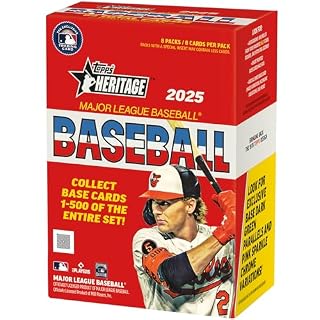
Topps 2025 Heritage Baseball - Value Box
Amazon →

2025 TOPPS Heritage HIGH Number Hobby Box
Amazon →
Frequently Asked Questions
How many cards are in the 2025 Topps Heritage checklist?
What are the variations in 2025 Topps Heritage?
What are the best cards in 2025 Topps Heritage?
How do you tell a 2025 Topps Heritage variation from a base card?
What are the short-print odds in 2025 Topps Heritage?
What parallels does 2025 Topps Heritage have?
What design does 2025 Topps Heritage use?
What's guaranteed in a 2025 Topps Heritage Hobby Box?
Other Set Checklists & Reviews
Every review below breaks down the same things this one does — base set structure, card numbering, the parallel ladder, and what the real chase cards are. Use them to compare how two sets are actually built before you decide which one to buy into.
2026 Topps Series 1 Baseball Review & Format Guide
Topps' 75th-anniversary flagship, headlined by Roman Anthony and the 2025 debut class. Retail packs run 14 cards, hobby packs 12 — and the retail-exclusive Holo Foil parallels and Spring Training variations are the chases hobby boxes can't produce.
2025 Topps Series 1 Baseball2025 Topps Series 1 Baseball Review & Checklist
A 350-card base set numbered #1–350, led by Ohtani at #1. The chase is the Golden Mirror, Team Color Border and True Photo image variations that hide in plain sight among the base cards.
2024 Topps Chrome Baseball2024 Topps Chrome Baseball Review & Checklist
A 300-card base set (#1–300) carrying 113 rookies. The chase is the Refractor rainbow, Speckle image variations and the Award Winners /23 short prints.
2025 Bowman Chrome Baseball2025 Bowman Chrome Baseball Review & Checklist
A 200-card base set split evenly — #1–100 base plus 100 BCP Chrome Prospects. The chase is the CPA on-card 1st Bowman autographs from the Holliday/Rainer prospect class.
2024 Bowman Chrome Baseball2024 Bowman Chrome Baseball Review & Checklist
A 200-card core in two halves — a #1–100 base run plus 100 BCP Chrome Prospects. The chase is the CPA prospect autos and Chrome Rookie Autos, and Skenes' 1st Bowman is not in it.